


Your webinar subject lines carry more weight than most people realize. They’re not just email marketing – they’re how people get their first glimpse into what you’re offering and whether it’s worth their time.
Effective webinar email subject lines are benefit-driven, personalized, and create urgency or curiosity to boost open rates. Though honestly, getting that balance right while avoiding the spam folder takes more finesse than most marketing guides show you.
The difference between subject lines that work and ones that get ignored often comes down to understanding something crucial about business inboxes. People aren’t just deciding whether to open your email – they’re evaluating whether the time investment will offer something they can actually use in their work.
Which means your subject line needs to clear a much higher bar than typical promotional content. You want them to see the value immediately, not guess what’s inside.
The difference between a well-crafted subject line and a generic one can mean the difference between a packed virtual auditorium and disappointing attendance numbers that impact your organization's knowledge-sharing objectives and development initiatives.


7 reasons why most email subject line advice is misguided
Standard advice about email subject lines treats them like isolated marketing copy, but that misses how they actually function in business contexts. The reality is, your audience is constantly triaging communications, and webinar invitations compete with internal updates, client correspondence, and industry newsletters that directly impact their quarterly objectives.
Effective webinar email subject lines are concise, highlight a clear benefit or a sense of urgency, and are personalized when possible. But there’s a nuance here that gets overlooked – the personalization has to feel genuine rather than automated.
Someone who sees “[First Name], don’t miss this opportunity!” immediately recognizes database merge fields. Contrast that with personalization that mirrors how colleagues actually communicate with each other.
1. Executive webinar invitations need different psychology than consumer marketing emails

The psychology shifts during webinar campaigns that serve organizational goals beyond just marketing metrics. Member engagement programs, continuing education requirements, regulatory compliance training – these create different motivational frameworks than typical lead generation.
Your subject lines need to acknowledge these underlying drivers without being heavy-handed about it.
Something interesting happens during the transition from treating subject lines as conversation starters rather than advertising headlines. The tone shifts from persuasive to consultative, which tends to work better with audiences who attend webinars to learn and build their expertise.
You’re not just trying to get them to register – you’re inviting them to join something that will make them better at what they do.
That’s a different appeal entirely, and it shows in how you craft your message.
2. Six words gets more opens than sixteen words every single time
Length optimization sounds straightforward until you actually try to write complex value propositions into digestible chunks. You want to keep your webinar invite subject lines between six and 10 words, though this guideline assumes every word carries equal weight.
Sometimes a slightly longer subject line that makes the benefits clear outperforms a shorter one that creates confusion about what people will actually learn.
The research consistently shows this is the engagement sweet spot, but there’s important context missing from those studies. Business audiences scan emails differently than consumers.
They’re looking for information about relevance and whether attending will give them something they can use right away.
That’s why clarity often beats brevity during outreach to people who need to see the value before they’ll take time out of their day to attend.
3. Mobile email apps cut off subject lines after 40 characters
Character count matters more than word count in practice. Keep subject lines under 40 characters so the full message displays on all devices – though this constraint forces some uncomfortable choices about what information to prioritize.
Most important details go first, because mobile email clients truncate aggressively. Under 60 characters gives you more flexibility while maintaining compatibility across email platforms.
There’s an interesting tension between brevity and clarity that doesn’t get discussed much. Sometimes the most concise option isn’t the clearest one, and clarity usually wins with business audiences who don’t have time to decode ambiguous messaging.
This balance becomes even more critical considering your subject line needs to work across different devices and email clients.
4. Using first names increases open rates by 39% when done right

Including recipients’ first names in your subject lines can boost open rates by up to 39%, but the execution matters more than the tactic itself. “[First Name], Become a [Topic] Expert on [Date]” works because it positions the webinar as a skill-building opportunity rather than a sales pitch.
“Hey [Name], will you be there?” creates a different dynamic – it feels more like an internal team invitation.
Effective personalized approaches mirror how people actually communicate in their organizations. Formal enough to feel appropriate, casual enough to suggest insider access.
This balance varies significantly across industries and organizational cultures, which makes testing essential.
Dynamic personalization goes beyond names to include job titles, company names, or industry-specific pain points. Though that level of segmentation requires more sophisticated email platforms and data management practices.
Sometimes simple name personalization outperforms complex dynamic content because it feels more authentic.
There’s also something to be said for selective personalization in your email sequence. Not every reminder or follow-up needs personalized subject lines.
Strategic use can make the personalized messages feel more significant rather than automated.
During your final reminder before the live event, you want them to feel like you’re speaking directly to them about this one opportunity they signed up for.
5. Numbers and emojis work but only for the right industry and audience
Numbers and emojis boost engagement rates, but their effectiveness depends heavily on audience expectations and industry norms. Research demonstrates that subject lines with emojis achieve higher click-through rates, while numbers suggest concrete, measurable outcomes that appeal to data-driven executives.
The approach centers on matching visual elements to your content and audience sophistication. A webinar about financial compliance might benefit from conservative formatting, while a session on social media marketing could accommodate more expressive approaches.
Context matters more than general best practices.
This context-driven approach extends to restraint in usage. Too many exclamation points trigger spam filters and signal desperation to experienced email recipients.
Numbers work best during genuine value propositions rather than artificial scarcity tactics. Visual consistency across your email sequences builds recognition and trust.
Organizations that use a particular approach to formatting webinar invitations maintain that pattern to help recipients quickly identify and prioritize your content.
6. FOMO subject lines get more opens but only when the scarcity is real

Effective urgency reflects real constraints rather than manufactured scarcity. “Only a Few Seats Left for [Webinar Name]!” works during actual capacity limitations.
“Last Chance to Register: Webinar on [Topic] – Limited Seats Left!” loses credibility if recipients know you’re using automated webinar platforms with unlimited capacity.
Subject lines that create FOMO show a 22% higher open rate than those that don’t, but business audiences are sophisticated about marketing tactics. The urgency needs to feel authentic to people who manage their own events and understand how webinar logistics actually work.
Building authentic urgency requires understanding what creates genuine time pressure for your audience. The reality is, legitimate deadlines create natural urgency without seeming manipulative.
Registration cutoffs for materials preparation, early-bird pricing expiration, or limited Q&A slots provide honest reasons for immediate action.
These constraints make sense to your audience because they mirror the operational realities they deal with in their own work.
Time-sensitive industry developments can also create urgency around educational content. Regulatory changes, market shifts, or breaking news that affects your audience’s duties provide context for immediate registration that feels helpful rather than pushy.
7. A/B testing subject lines reveals what your audience actually wants
A/B testing reveals audience preferences you can’t predict through intuition alone. Test variables including recipient name versus no name, urgency versus benefit-focused messaging, emoji usage, and descriptive copy versus webinar titles.
But design these tests to produce actionable insights rather than just statistical significance.
Different audience segments often respond to completely different approaches. Senior executives might prioritize efficiency messaging while mid-level managers engage more with skill-building opportunities.
Business associations serve diverse member bases that require segmented communication strategies.
The goal centers on building systematic understanding of what motivates your specific business community rather than optimizing for general email marketing benchmarks. Industry-specific preferences, organizational culture variations, and role-based priorities all influence subject line effectiveness in ways that generic advice doesn’t address.
Continuous testing also helps you adapt to changing communication preferences and market conditions.
What worked before major industry shifts or economic changes might not resonate the same way with audiences who are dealing with new pressures and priorities.
Different subject lines work at every stage
Each stage of your webinar marketing sequence requires different psychological approaches that acknowledge where people are in their decision-making process. The problem is, most organizations use the same tone throughout their entire sequence:
- Invitation phase – Competing with every other development opportunity for attention
- Confirmation stage – Reinforcing the registration decision and building anticipation
- Reminder sequence – Maintaining engagement momentum while respecting busy schedules
- Post-event follow-up – Maximizing value delivery and nurturing future relationships
Understanding this progression helps you craft messages that feel appropriate to their moment rather than using the same tone throughout your entire sequence.
1. Invitation subject lines compete with every other email in their inbox
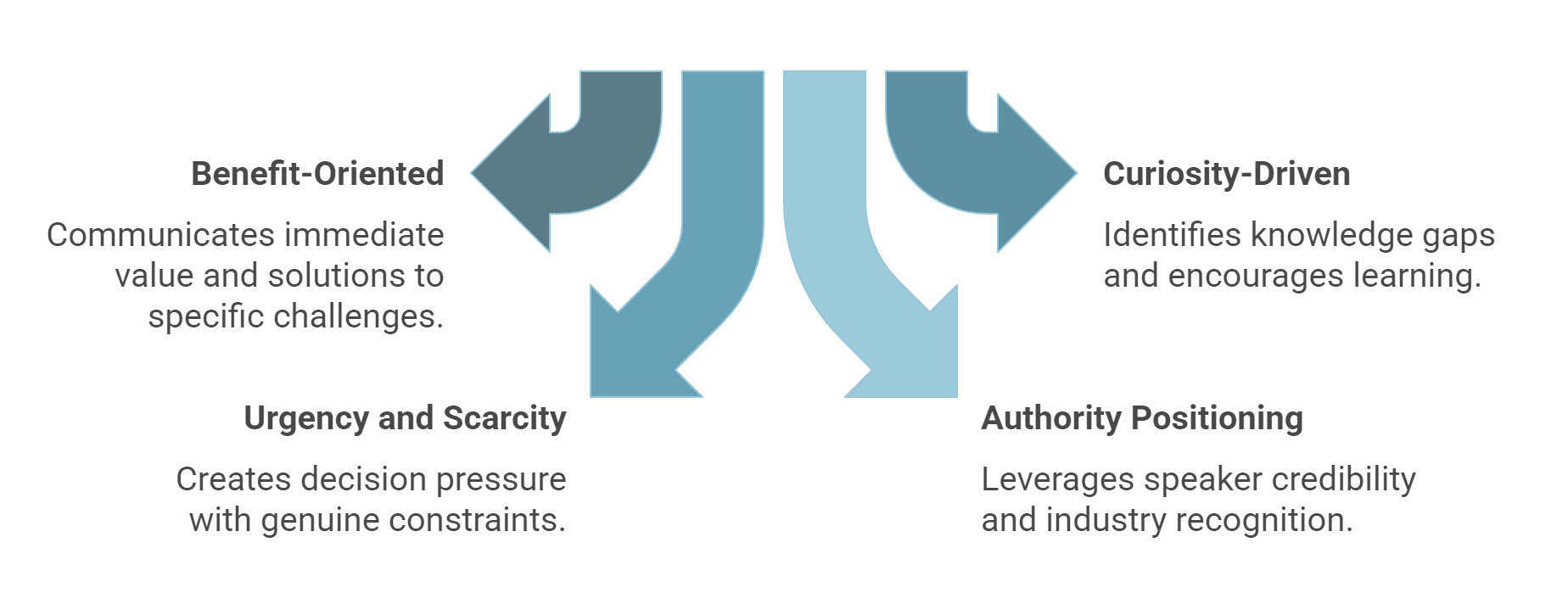
Initial outreach competes with every other development opportunity your audience considers, plus all their regular work responsibilities. We’ve found four main approaches prove most effective at this stage.
Benefit-oriented strategies communicate immediate value through clear examples of what attendees will learn. “Unlock [Benefit]: Join Our Free Webinar on [Topic]” works because it positions your session as a solution to specific challenges they face every day.
“Boost Your [Skill] in Just One Hour – Free Webinar!” addresses the time investment concern directly while emphasizing practical outcomes they can use immediately.
Curiosity-driven approaches complement benefit messaging by identifying knowledge gaps that ambitious people want to fill. “What’s Missing from Your [Industry] Strategy? Find Out Here” directly addresses strategic planning concerns.
“Are You Making These Common [Topic] Mistakes? Learn How to Avoid Them” combines curiosity with problem-solving benefits.
Urgency and scarcity messaging creates decision pressure, but needs to reflect genuine constraints. “Limited Spots Available! Register for [Topic] Webinar Now” works during actual capacity limitations.
“Don’t Miss Our Webinar This [Month]!” creates temporal urgency without specific scarcity claims.
Authority positioning uses speaker credibility through approaches like “Meet the Speakers of [Webinar Title]” or “Upcoming Webinar and Q&A with [Presenter Name].” This strategy proves particularly effective during sessions with speakers who have strong industry recognition.
Creating enough curiosity that people want to learn more, while being clear about what they'll actually get during attendance, forms the foundation of these invitation approaches.
2. Confirmation and reminder emails need to build excitement not just share logistics
Once someone registers, your communication objectives shift from persuasion to expectation management and engagement maintenance. Two types of messages serve this stage effectively:
Confirmation messaging should validate the registration decision while providing all the essential information they need to attend. “Webinar Confirmation: [Webinar Name] on [Webinar Date]” delivers practical details in a straightforward format that people can easily add to their calendar.
“Your Webinar Spot is Reserved – Details Inside” reassures registrants while encouraging them to open the email for the link to join and preparation resources.
Reminder communications become increasingly important as the event approaches, since busy people often register with good intentions but need multiple touchpoints to prioritize attendance. “Just Hours Away: Join Our [Webinar Name] Today!” creates immediate urgency for imminent events.
“Reminder: [Webinar Name] Starts Tomorrow, [First Name]!” combines personalization with time-specific urgency.
These communications acknowledge that your audience juggles multiple commitments and may need help prioritizing your webinar over competing demands.
3. Post webinar subject lines turn one time attendees into long term community members
Post-webinar communications serve dual strategic purposes – maximizing value delivery to attendees while nurturing non-attendees for future engagement opportunities. Three main approaches work effectively:
- “Thank You for Attending! Here’s the [Webinar] Replay” acknowledges participation while providing permanent access to the content for future reference or sharing with colleagues.
- “Missed the Webinar? Catch the Recording and Key Insights” offers redemption opportunities for registrants who couldn’t attend live, maintaining goodwill for future events.
- “Here’s the [Topic] Webinar Recording and Bonus Materials” goes beyond basic replay access to include supplementary resources like slides, templates, or additional readings that enhance the original presentation.
These follow-up communications also provide opportunities to gather feedback, promote related events, and begin conversations that might lead to deeper organizational relationships.
4. Tech companies need different subject lines than nonprofits and associations

Different industries and company types need slightly different approaches to webinar subject lines, though the same principles remain consistent. What works for a SaaS platform might not resonate with a nonprofit organization, and what appeals to C-level executives differs from what attracts mid-level managers looking to build new skills.
For technology companies and SaaS platforms, subject lines that emphasize proven results and specific outcomes tend to perform better. Your audience expects concrete benefits and measurable improvements they can show their team or use to advance their career.
They want to know exactly what they’ll learn and how it applies to their daily work.
Associations and nonprofits often see better results with subject lines that focus on exclusive access and expert insights. Their members join these organizations specifically to learn from industry leaders and get information they can’t find elsewhere.
The appeal is about being part of a select group that gets access to valuable knowledge and networking opportunities.
Corporate training and internal webinars need subject lines that acknowledge busy schedules while emphasizing career development benefits. These audiences are often attending as part of their development requirements, so the messaging should make clear how the session will help them in their current role and future advancement.
Perfect subject lines mean nothing if your emails never reach the inbox
Beyond crafting compelling subject line copy, several technical factors determine whether your webinar invitations actually reach their intended recipients and display properly across different email platforms.
These behind-the-scenes elements can make or break even the most carefully crafted subject lines.
Gmail shows 60 characters while Outlook shows 40 characters
Different email platforms handle subject lines differently, which affects how your carefully crafted messages appear to recipients. Outlook truncates subject lines more aggressively than Gmail, while mobile email apps have their own display quirks that can cut off important information.
What looks perfect in your email marketing platform might appear broken or incomplete during delivery to your audience’s actual inbox.
Understanding these platform differences becomes crucial during outreach to diverse business audiences who use various email systems. The preview text becomes even more crucial considering these technical limitations.
Many email clients show preview text alongside or below the subject line, giving you additional space to communicate value during subject line truncation.
But this preview text pulls from the first line of your email body if you don’t set it explicitly, which often results in generic text like “View this email in your browser” appearing instead of compelling content.
Modern spam filters check way more than just trigger words
Modern spam filters evaluate much more than just trigger words during determination of whether your webinar invitations reach the inbox. Your sender reputation, domain authentication, and even the ratio of text to images in your email template all influence deliverability.
A perfectly crafted subject line becomes useless if the email never makes it past these automated screening systems.
These technical factors work behind the scenes but directly impact your marketing success. The reality is, authentication protocols like SPF, DKIM, and DMARC directly impact whether your business audience receives your webinar invitations.
Organizations with poor email authentication often see their messages relegated to spam folders regardless of subject line quality, which explains why some webinar campaigns underperform despite following all the traditional best practices.
Most email platforms have features you’ve never used that double open rates
Different email marketing platforms offer varying levels of control over how your subject lines appear and perform. Some allow you to test subject lines across multiple email clients before sending, while others provide real-time feedback about potential deliverability issues based on your content and recipient list characteristics.
Understanding your specific platform’s capabilities helps you optimize beyond just the text itself. Features like send time optimization, automatic subject line testing, and deliverability scoring can significantly impact your webinar registration rates, but only if you know they exist and how to use them effectively.
Many organizations leave these technical optimizations unused, focusing solely on creative elements while ignoring the underlying systems that determine message delivery and display.
Advanced strategies that separate amateur email marketing from professional results

Beyond tactical execution, four sophisticated strategies distinguish high-performing communications from amateur email marketing:
Message clarity and business positioning requires explicit communication about webinar content and value delivery while avoiding vague language that forces recipients to guess about relevance. Subject lines should function like executive summaries, providing enough information for quick decision-making.
Spam filter navigation and credibility involves understanding that certain promotional language can undermine your organization’s reputation even during successful technical spam filter passage. Strategic language choices demonstrate awareness of business communication norms while still conveying value.
Preview text optimization represents underutilized strategic real estate that can significantly impact open rates during effective usage. This space provides opportunities to reinforce your main message or offer additional context that helps busy people quickly evaluate opportunities.
Continuous performance optimization through systematic testing ensures your approach evolves with changing audience preferences and business priorities. Understanding deeper engagement patterns helps you make strategic decisions about communication frequency and message positioning.
These approaches require deeper understanding of business communication patterns and audience psychology than basic tactical implementation.
Effective webinar email marketing programs treat subject line optimization as an ongoing strategy rather than a one-time task. This means continuously testing different approaches, learning from what works with your specific audience, and adapting your templates based on real results rather than general best practices.
Your goal centers on attracting the right people who will actually attend, engage with your content, and get value from the experience.
That requires understanding not just how to write compelling subject lines, but how to craft an entire email sequence that guides people from initial interest to active participation.
Subject lines are just the beginning of building a webinar program that actually drives revenue
Crafting compelling subject lines is just one piece of successful webinar marketing. To maximize registration rates and attendance, you need integrated production, platform strategy, and promotional campaigns that work together seamlessly.
We & Goliath’s full-service approach handles everything from email marketing optimization to livestream production, saving organizations 100+ hours while delivering measurable results. Ready to turn your webinar program into a revenue-driving asset?
Schedule your free strategy session to discover how expert guidance can transform your events from good to extraordinary.


